Important Note!
We use cookies to ensure you get the best experience on our website.
By clicking ‘Agree,’ you accept our use of cookies as outlined in our cookies policy

This week’s key economic releases, including U.S. GDP, unemployment claims, and the Core PCE Price Index, could drive market volatility. Germany’s inflation data and China’s Manufacturing PMI will also be in focus.
In FX markets, the yen has strengthened against the euro as traders react to shifting technical signals and Japan’s evolving monetary policy. With the ECB expected to cut rates and the BOJ signaling possible hikes, EURJPY remains under pressure, with key support and resistance levels in play.
Thursday 15:30 (GMT+2) – USA: Prelim GDP q/q (USD)
Thursday 15:30 (GMT+2) – USA: Unemployment Claims (USD)
Friday All Day – Germany: German Prelim CPI m/m (EUR)
Friday 15:30 (GMT+2) – Canada: GDP m/m (CAD)
Friday 15:30 (GMT+2) – USA: Core PCE Price Index m/m (USD)
Saturday 03:30 am (GMT+2) – China: Manufacturing PMI (CNY)
Since reaching a peak of 164.891 on December 30, the Japanese yen has strengthened against the euro, driven by a confluence of technical and fundamental factors. The formation of an Evening Star candlestick pattern at the top signaled a shift in market sentiment, indicating buyer exhaustion and the potential for a trend reversal. The reversal was confirmed by a failure swing where the peak, 164.539, held below the prior peak and subsequently prices fell below 160.885.
This bearish bias was further validated as EURJPY broke below the 20- and 50-period Exponential Moving Averages (EMAs), highlighting a structural transition. The subsequent formation of a “Death Cross,” where the 20-period EMA crossed beneath the 50-period EMA, reinforced downside momentum. Meanwhile, the Momentum Oscillator and Relative Strength Index (RSI) both fell below critical levels of 100 and 50, respectively, underscoring the strength of the emerging downtrend.
A sustained break below the key support level at 155.586 would likely accelerate downside pressure, opening the way for further declines in the EURJPY pair.
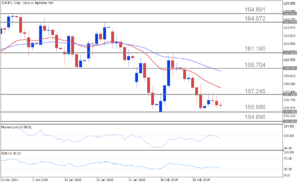
If buyers take control of the market, traders may shift their focus to the following four potential resistance levels:
157.246: The initial price target is established at 157.246, corresponding to the weekly Pivot Point, PP, estimated using the standard methodology.
159.704: The second level of resistance is seen at 159.704, which aligns with the daily low from January 17.
161.180: The third price target is determined at 161.180, representing the peak marked February 13.
164.072: An additional price objective is estimated at 164.072, mirroring the peak formed on January 24.
If sellers maintain control of the market, traders may focus on the following four key support levels:
155.586: The initial support level is established at 155.586, representing the daily low marked February 10.
154.696: The second support level is seen at 154.696, aligning with the weekly support, S1, calculated using the standard Pivot Points methodology.
153.251: The third downside target is 153.251, corresponding to the weekly support, S2, estimated using the standard Pivot Points methodology.
152.129: An additional downside target is observed at 152.129, reflecting the 161.8% Fibonacci Extension drawn from 155.586 to 161.180.
Euro-area wage growth slowed in the fourth quarter of 2024, reinforcing expectations that the European Central Bank (ECB) will continue cutting interest rates. Negotiated wages rose 4.1% year-over-year, down from a record 5.4% in the previous quarter. The data suggests pay increases are moderating after catching up with inflation, potentially easing persistent services inflation. With the labor market softening and firms expecting further wage deceleration, the ECB is widely expected to cut rates again at its March 6 meeting. However, officials remain cautious, noting that wage growth remains relatively high.
On the other hand, yen traders are increasingly focused on Japanese economic data, reflecting a shift in market dynamics as the Bank of Japan (BOJ) moves away from its long-standing ultra-loose policy. Recent wage and GDP data triggered some of the biggest yen movements in years, signaling heightened sensitivity to domestic indicators. Strong economic figures could support further BOJ rate hikes, boosting the yen’s appeal. While some investors are bullish, margin traders continue to bet against the currency. However, if the BOJ maintains its tightening path, the yen may see further gains.
With several high-impact economic releases on the horizon, market volatility is expected to remain elevated. Key data from the U.S., Germany, Canada, and China will shape investor sentiment, particularly around inflation and growth expectations.
In FX markets, EURJPY remains under pressure as technical indicators confirm a bearish bias, while diverging monetary policies between the ECB and BOJ add to the yen’s upside potential. Traders should closely monitor key support and resistance levels, as well as upcoming data releases, for further directional cues.

The XAUUSD H4 chart is showing an interesting potential bullish reversal structure after a significant decline from the 4,650–4,690 region toward the 4,080–4,085 area....


The AUDUSD weekly chart continues to show an interesting bullish Elliott Wave structure following the strong recovery from the previous major low.

Get the FXGT App