Important Note!
We use cookies to ensure you get the best experience on our website.
By clicking ‘Agree,’ you accept our use of cookies as outlined in our cookies policy

With the week already in motion, traders are preparing for a series of high-impact economic releases that could shape market sentiment heading into the weekend. Key data from the US, UK, and Eurozone — including employment figures, retail sales, and flash PMI readings — are likely to drive volatility across major assets. At the same time, crude oil remains a focal point, with prices extending their downtrend and hovering below the $60 mark, adding another layer of interest as markets digest both macroeconomic signals and shifting energy fundamentals.
Thursday 15:30 (GMT+2) – USA: Non-Farm Employment Change (USD)
Friday 09:00 am (GMT+2) – UK: Retail Sales m/m (GBP)
Friday 10:30 am (GMT+2) – Germany: Flash Manufacturing PMI (EUR)
Friday 10:30 am (GMT+2) – Germany: Flash Services PMI (EUR)
Friday 11:30 am (GMT+2) – UK: Flash Manufacturing PMI (GBP)
Friday 11:30 am (GMT+2) – UK: Flash Services PMI (GBP)
Friday 16:45 (GMT+2) – USA: Flash Manufacturing PMI (USD)
Friday 16:45 (GMT+2) – USA: Flash Services PMI (USD)
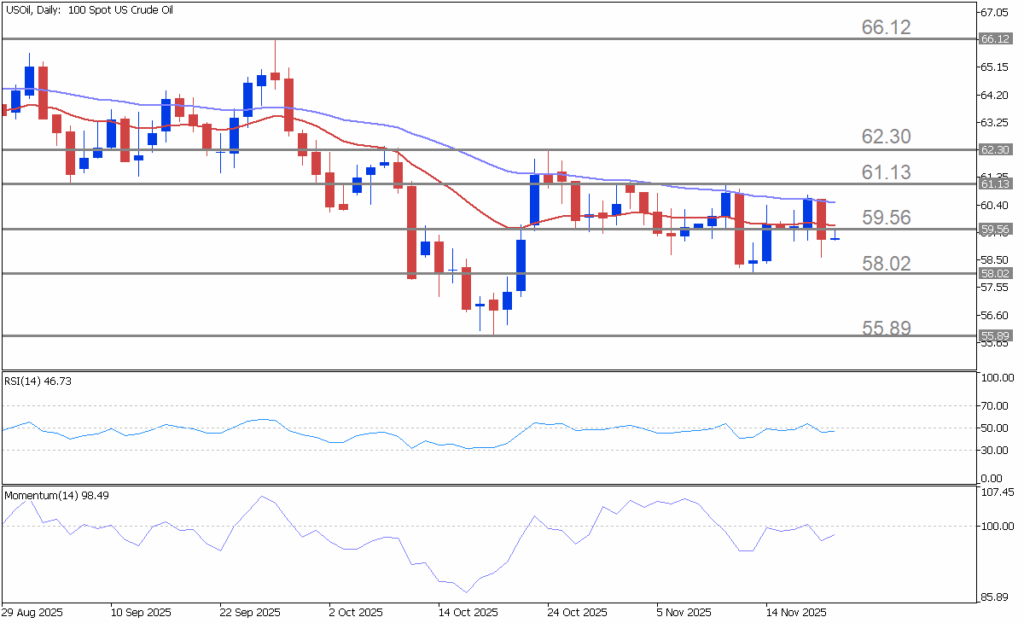
Crude oil has remained under sustained downside pressure since topping at $76.64 per barrel on 23 June, where a Bearish Engulfing formation signaled the start of a potential trend reversal. The market subsequently entered a multi-week consolidation phase, but the structure ultimately resolved to the downside with a decisive break below the range floor at $63.64, opening the door for further weakness.
Trend dynamics continue to favor sellers. A confirmed Death Cross — with the 20-period EMA sliding beneath the 50-period EMA — has strengthened the bearish narrative and encouraged additional follow-through selling. Momentum indicators are aligned with this structure: the Momentum Oscillator remains below its 100 baseline, while the Relative Strength Index (RSI) is firmly capped beneath the 50 level, both reflecting persistent downside momentum.
At present, crude oil is trading below the key $60.00 psychological threshold, last quoted around $59.29 per barrel, keeping the broader bearish bias intact.
Should the buyers take market control, traders may direct their attention toward the four potential resistance levels below:
59.56: The first price target is determined at 59.56, representing the weekly Pivot Point, PP, calculated using the standard methodology.
61.13: The second target is set at 61.13, corresponding to the high point from November 3.
62.30: The third price target is established at 62.30, which reflects the swing high from October 24.
66.12: An additional resistance is seen at 66.12, aligning with the high point marked on September 26.
Should the sellers keep market control, traders may consider the four potential support levels listed below:
58.02: The primary downside target is observed at 58.02, corresponding to the daily low marked on November 13.
55.89: The second support level is identified at 55.89, representing the swing low marked on October 20.
54.88: The third support line is established at 54.88, corresponding to the weekly support, S3, estimated using the standard Pivot Points methodology.
53.51: An additional downward target is recognized at 53.51, reflecting the 423.6% Fibonacci Extension drawn from 59.40 to 61.22.
US refineries processed more crude oil last week, running at 90% capacity and handling 16.2 million barrels per day — slightly higher than the week before. Despite the higher refinery activity, gasoline and distillate (like diesel and heating oil) production both declined.
Crude oil imports increased to 6.0 million barrels per day, although the four-week average is still well below last year’s levels. Gasoline and distillate imports also remained modest.
US commercial crude oil inventories fell by 3.4 million barrels, leaving stockpiles about 5% below the five-year average — a sign of a relatively tight market. Gasoline inventories rose slightly but are still 3% below normal for this time of year. Distillate inventories also increased but remain 7% under the five-year average. Propane supplies are strong, sitting well above typical seasonal levels.
Overall, petroleum inventories declined by 2.7 million barrels. Meanwhile, fuel demand (measured by products supplied) was essentially flat compared to last year. Gasoline demand dipped slightly, diesel demand held steady, and jet fuel demand continued to grow.
With crude oil prices locked in a clear downtrend and fundamentals showing steady refinery activity alongside mixed import and demand trends, the market remains tilted toward a bearish bias. This week’s high-impact economic releases could inject volatility across asset classes, potentially influencing crude demand expectations and short-term price momentum. Traders should remain alert to both macroeconomic surprises and technical breakouts from key support or resistance levels.



Global financial markets experienced a volatile week as investors reacted to major economic reports, corporate earnings, and ongoing economic uncertainty.

The week of October 19–23, 2026, brings several high-impact economic events that could influence global financial markets.

Get the FXGT App