Important Note!
We use cookies to ensure you get the best experience on our website.
By clicking ‘Agree,’ you accept our use of cookies as outlined in our cookies policy

Gold is currently trading inside a corrective triangle after completing the previous impulsive decline. The current consolidation appears to be developing as a Wave 4 correction before the market potentially resumes its primary bearish trend.
Price is approaching a key swap zone and the upper boundary of the triangle, making this a crucial area where selling pressure may return.
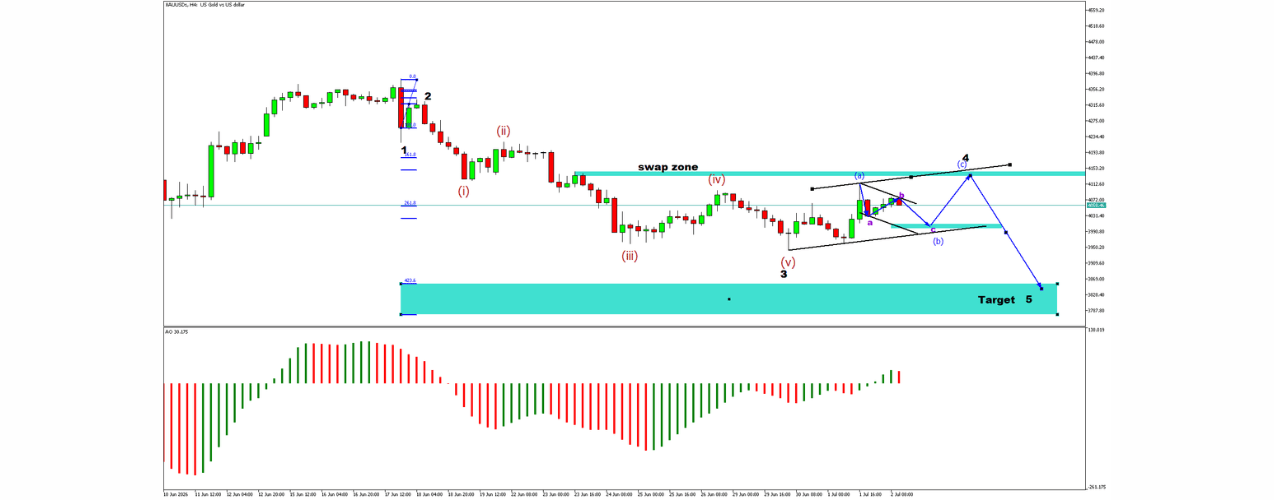
The Elliott Wave structure suggests that Waves (i), (ii), (iii), (iv), and (v) have completed the previous bearish cycle, followed by a corrective Wave 4 triangle.
The ongoing ABC corrective pattern is approaching its final stage. If the triangle completes as expected, Gold could break lower and begin Wave 5, extending the bearish move toward the projected Fibonacci 423.6 extension target.
A confirmed rejection from the upper trendline and swap zone would reinforce the bearish outlook.
A sustained breakout above the triangle resistance would invalidate the immediate bearish scenario and increase the probability of a larger bullish correction.
The Awesome Oscillator has turned positive, indicating that bullish momentum is supporting the ongoing corrective rally.
However, momentum remains relatively moderate and has not confirmed a broader trend reversal. As long as price stays below the major resistance zone, the current momentum is likely part of the corrective structure rather than the beginning of a new bullish trend.
Traders should monitor the oscillator closely for signs of bearish divergence near resistance.
The preferred scenario remains bearish while Gold trades within the corrective triangle.
A rejection from the swap zone and the upper trendline could trigger the start of Wave 5, with downside targets focused on the Fibonacci 423.6 extension zone shown on the chart.
Confirmation through bearish candlestick patterns and weakening momentum would strengthen the probability of the next impulsive decline.


What makes it possible for a trader to gain exposure to the S&P 500, gold, a major technology company, the US dollar, or Bitcoin, all from a single trading account? The a...


The XAUUSD H4 chart is showing an interesting potential bullish reversal structure after a significant decline from the 4,650–4,690 region toward the 4,080–4,085 area....

Get the FXGT App